

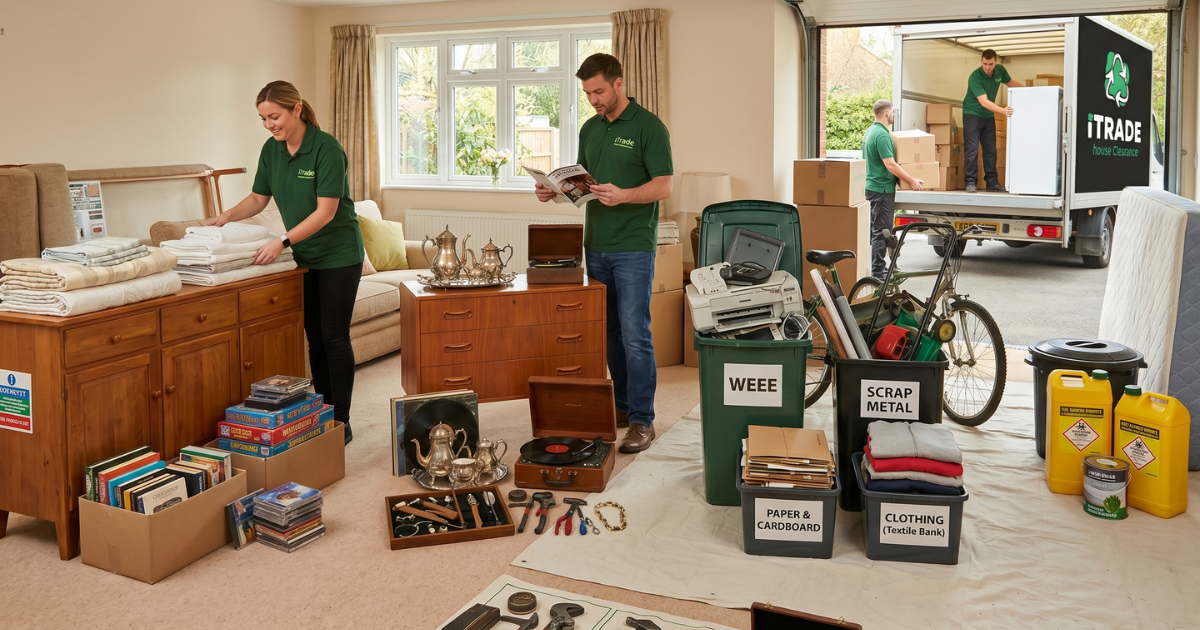
Clearing a house — whether it’s your own, a family member’s, or a property you’ve inherited — is rarely a straightforward task. You’re faced with decades of accumulated belongings, and the pressure to clear everything quickly can make it tempting to skip past the question of what’s actually worth saving, selling, or recycling. But here’s what most people don’t realise: a significant proportion of items found during a house clearance have genuine resale value, can be donated to support good causes, or can be kept out of landfill through responsible recycling. Getting this right doesn’t just save money — it’s better for the environment, better for the community, and increasingly expected under UK waste legislation. At iTrade House Clearance, we handle all of this on behalf of our clients every day. In this guide, we’ll walk you through exactly what can be reused, recycled, or sold — and how to make the most of what’s left behind. What Items Can Be Reused During a House Clearance? Reuse sits at the top of the waste hierarchy for good reason. If something still works or still looks good, extending its life is far better than breaking it down for recycling or sending it to landfill. Furniture Solid wood furniture — sideboards, wardrobes, dining tables, chest of drawers — holds up remarkably well over time. Many pre-1980s pieces were built to a standard that modern flat-pack simply can’t match. Upholstered sofas and armchairs in reasonable condition are also prime candidates for reuse, especially if the frames are still sturdy. Flat-pack furniture in good condition can also find a second home, though its resale or donation value is generally lower than solid pieces. Household Textiles and Soft Furnishings Curtains, cushions, bedding, towels, and rugs that are clean and undamaged can all be passed on. Textile banks and charity shops accept a wide range of fabric items, and some specialist organisations collect curtains specifically for redistribution. Books, CDs, DVDs and Games These are easy wins during a clearance. Books in readable condition, DVDs, CDs, and games consoles or boxed games are widely accepted by charity shops and online resale platforms. Children’s books in particular are always in demand. Garden Equipment and Tools Manual tools such as spades, forks, rakes, and hand tools are durable and easy to pass on. Larger equipment like lawnmowers and strimmers can also be reused if they’re in working order — and if not, they often still have value as scrap metal or spare parts. Kitchenware and Small Appliances Crockery, glassware, pots, pans, and small kitchen appliances such as toasters, kettles, and food processors can all be donated or sold if they’re in good condition. Kitchen equipment is consistently popular in charity shops and at car boot sales. What Can Be Recycled During a House Clearance? Where reuse isn’t possible, recycling is the next best option. Getting this right during a clearance can divert a large volume of material from landfill. Electrical Appliances and WEEE Regulations Waste electrical and electronic equipment — commonly referred to as WEEE — is subject to specific regulations in the UK. Items like washing machines, fridges, televisions, laptops, printers, and mobile phones cannot be disposed of in general household waste. They must be taken to a WEEE-compliant recycling facility or collected by a registered waste carrier. This includes both large white goods and smaller electronics. Many local councils offer free collection or designated WEEE recycling points, and retailers are also required by law to accept old electrical items when you purchase a replacement. At iTrade House Clearance, we handle WEEE disposal in full compliance with these regulations, so you won’t face any liability. Scrap Metal Metal is one of the most widely and efficiently recycled materials in the UK. Aluminium, copper, steel and iron — whether found in old tools, appliances, pipes, guttering, or general metalwork — can all be processed through scrap metal recycling. Depending on the type and quantity, scrap metal may also have direct monetary value. Paper, Card and Packaging Books too damaged to donate, cardboard boxes, old paperwork, and general paper waste are all recyclable through council collections or household recycling centres. Glass Glass bottles, jars, and certain types of decorative glass can be recycled. Note that Pyrex, mirrors, and window glass are typically not accepted in domestic recycling collections and require separate disposal. Clothing and Textiles Clothing that’s too worn for donation can still be diverted from landfill through textile recycling banks or specialist clothing collectors. Many councils partner with textile recycling schemes, and charities like Oxfam and the Salvation Army often accept torn or damaged clothing for processing. What Items Can Be Sold for Value? A house clearance is also an opportunity for value recovery. You’d be surprised what items command a good price — particularly if the property belonged to someone who accumulated belongings over several decades. Antiques and Collectibles Antique furniture, ornaments, silverware, clocks, ceramics, vintage jewellery, and original artwork can be highly valuable. Identifying these pieces requires some knowledge, as genuine antiques are often mixed in with reproduction pieces that look similar but carry no real value. An estate clearance through a company with experience in identifying saleable items is valuable here — rather than discovering too late that a piece was worth selling. Vintage and Mid-Century Furniture Mid-century modern furniture — particularly pieces from the 1950s to 1970s — has surged in popularity. G-Plan, Ercol, and Heal’s pieces in original condition regularly achieve strong prices at auction or through specialist dealers. Vinyl Records and Hi-Fi Equipment Vinyl records have seen a significant resurgence. Collections found during a house clearance can range from worthless to extremely valuable depending on the artist, pressing, and condition. Original jazz, folk, and progressive rock pressings are particularly sought after. Vintage hi-fi equipment from brands like Leak, Quad, or Wharfedale is similarly collectible. Tools and Workshop Equipment Quality hand tools from brands like Stanley, Record, and Marples hold their value well in second-hand markets. Power tools in working condition from brands

What Items Are Valuable in a House Clearance?
House clearance is often misunderstood as a simple removal job—empty a property, load a van, and dispose of everything. In reality, a well-managed clearance is closer to a structured asset recovery process. Hidden within most homes are items that still hold resale value, collectible demand, or material worth. At iTrade House Clearance Norfolk, every clearance is approached with one objective: identify what can be reused, resold, donated, or recycled before anything is treated as waste. This approach not only reduces environmental impact but often offsets clearance costs significantly. Understanding what holds value—and why—is the difference between a standard clearance and a financially efficient one. How Value Is Actually Determined in House Clearances Value in a clearance context is not random. It is based on predictable market behavior driven by demand, rarity, condition, and resale channels. There are four key valuation drivers: 1. Market Demand Items with active buyer demand can be quickly resold through platforms like eBay. Demand fluctuates, but categories like electronics, furniture, and collectibles consistently perform well. 2. Rarity and Collectability Items that are no longer produced or belong to limited production runs increase in value over time. This is especially true for antiques, vintage goods, and certain branded collectibles. 3. Material Value Some items are valuable purely for their raw materials, particularly precious metals like gold and silver. 4. Condition and Usability Working condition plays a major role. Even average items can become valuable if they are functional, clean, and ready for resale. Understanding these factors helps distinguish between genuine waste and overlooked assets. Antiques and Vintage Items: Hidden High-Value Assets One of the most consistently undervalued categories in house clearances is older furniture and decorative items. Key examples include: Antiques are not just old items—they are items tied to historical craftsmanship, design movements, and limited production eras. Mid-century furniture, for example, is still highly sought after due to its design simplicity and durability. However, condition matters. Even damaged antiques may retain value if they are repairable or rare enough. In many cases, restoration significantly increases resale price. Auction houses such as Sotheby’s and Christie’s often handle higher-value pieces, especially when provenance is available. Jewellery and Precious Metals: Small Items, Big Value Jewellery is one of the most underestimated categories during house clearances. Common overlooked items include: Even items that appear broken or unfashionable retain intrinsic value due to metal content. Gold and silver prices are globally traded, meaning even small quantities can generate significant returns. A key mistake homeowners make is treating jewellery as sentimental clutter rather than liquid assets. In professional clearance scenarios, these items are typically separated immediately for valuation rather than disposal. Artwork, Books, and Collectibles: Cultural Value Matters Cultural and intellectual goods often hold value beyond their physical form. Key categories include: Books, in particular, are frequently underestimated. First editions, signed copies, or niche academic publications can have strong demand among collectors. Artwork value depends heavily on artist reputation, condition, and provenance. Even unsigned or decorative pieces may hold resale value if they match current interior design trends. Collectibles span a wide range—from coins and stamps to memorabilia and branded promotional items. Their value is driven almost entirely by rarity and collector interest rather than utility. Electronics and Modern Household Goods Unlike antiques, modern items have shorter value cycles but still strong resale potential. Key categories include: Electronics depreciate quickly, but functional devices still have strong secondary demand, particularly when sold through refurbished channels or resale platforms. White goods are especially valuable when they are energy-efficient and in working condition. Even older appliances may be resold for parts or export markets. Furniture, Tools, and Practical Equipment Large household items are often ignored because they are difficult to move or visually outdated. However, they frequently carry consistent resale value. Examples include: Solid wood furniture is particularly valuable due to durability and refurbishment potential. Even scratched or worn pieces can be restored and resold. Tools are another strong category because they retain functionality over long periods. Branded power tools especially maintain resale demand in both consumer and trade markets. Learn More: Waste Carrier License Explained: A Complete UK Guide for Businesses Where Valuable Items Are Sold or Redirected Once identified, valuable items typically follow structured disposal or resale channels: Online resale Many everyday goods are listed on eBay due to its broad buyer base and fast turnover. Auctions for higher-value items Premium or rare items are often directed to auction houses such as Sotheby’s or Christie’s where specialist buyers compete for them. Charitable redistribution Usable but lower-value items are often donated to organisations like British Heart Foundation, extending product life cycles and supporting community funding. Recycling and waste recovery Non-reusable materials are processed through a Recycling Centre to minimise landfill impact. In structured scenarios like Estate Sale or legal cases such as Probate Clearance, these channels are often combined strategically. Common Mistakes People Make During House Clearances Most value loss happens due to poor identification, not lack of assets. Typical mistakes include: These errors can significantly reduce the financial return of a clearance. A trained clearance team avoids these losses by systematically sorting items before disposal decisions are made. Why Professional House Clearance Changes the Outcome A professional service like iTrade House Clearance Norfolk does not simply remove contents—it evaluates, categorises, and redirects items through appropriate value channels. This includes: In many cases, recovered value can reduce overall clearance costs or, in certain estates, significantly offset them. Learn More: Environmentally Responsible House Clearance – How It Works Final Perspective A house clearance is not just about emptying a property—it is about understanding what still holds economic, material, or cultural value. The most commonly valuable items include: When properly assessed, these items move through resale platforms, auction houses, charitable organisations, or recycling systems instead of being discarded.At iTrade House Clearance Norfolk, the focus is always on ensuring that value is not lost through rushed disposal decisions. Every property contains hidden assets—the key is knowing how to identify them correctly.

Environmentally Responsible House Clearance – How It Works
When it comes to clearing a property, most people focus on the practicalities: what needs to go, how quickly, and what it will cost. What often gets overlooked is where everything ends up. In the UK alone, millions of tonnes of household waste are generated each year, and a significant portion of it comes from house clearances carried out without any thought for the environment. At iTrade House Clearance Norfolk, we believe there’s a better way. Environmentally responsible house clearance isn’t just a marketing phrase — it’s a genuine commitment to reducing landfill waste, giving usable items a second life, and handling disposal in a way that’s considerate of both people and the planet. This article explains what eco-friendly house clearance actually involves, how the process works from start to finish, and why it matters who you choose to carry out the work. What Is Environmentally Responsible House Clearance? Environmentally responsible house clearance is the practice of clearing a property in a way that prioritises recycling, reuse, and proper waste disposal — rather than simply loading everything into a skip and sending it to landfill. It means sorting items carefully, identifying what can be donated, what can be recycled, and what genuinely has no further use. It means working with local charities, recycling facilities, and waste carriers who are licensed and accountable. And it means providing customers with the reassurance that their unwanted belongings are being handled ethically. This approach is particularly important during estate clearances, where sentimental or valuable items may be mixed in with general rubbish — and where families often want to know that their loved one’s possessions have been treated with care rather than tipped indiscriminately. How the Process Works: Step by Step 1. Initial Assessment and Quote The process begins with a site visit or a detailed conversation about the property. The team at iTrade House Clearance Norfolk will assess the volume and nature of items to be cleared — furniture, appliances, clothing, books, garden equipment, and general household contents. This helps them plan the most efficient and responsible clearance. An honest, no-obligation quote is provided upfront, with no hidden charges. 2. Sorting and Categorising Items On the day of clearance, every item is assessed individually. Rather than treating the entire contents of a property as “waste,” the team separates items into distinct categories: This careful sorting process is what sets a genuinely eco-conscious house clearance apart from a simple skip-hire operation. 3. Removal and Loading Everything is loaded efficiently and safely. The team at iTrade House Clearance Norfolk is trained to handle bulky items, fragile antiques, and awkward spaces with care. Whether it’s a loft full of boxes or a full-house clearance after a bereavement, the work is carried out respectfully and professionally. 4. Delivery to Appropriate Destinations Items don’t all go to the same place. Donated goods go to local charities and furniture reuse projects. Recyclable materials go to licensed recycling centres. Only genuine waste goes to approved waste transfer facilities — and the company operates within UK waste carrier regulations throughout. 5. Completion and Confirmation Once the clearance is complete, customers receive confirmation that the work has been done properly. Where requested, iTrade House Clearance Norfolk can provide documentation of where items have been taken — useful for clients who need peace of mind or require waste transfer notes for legal or estate purposes. Recycling and Responsible Waste Management One of the most significant environmental impacts of any house clearance is what happens to materials that can’t be donated or reused. Responsible recycling is essential — and it’s an area where many clearance companies fall short. At iTrade House Clearance Norfolk, recyclable materials are sorted and taken to appropriate licensed facilities. This includes: Metals – Steel, aluminium, copper, and other metals from appliances, furniture frames, and fixtures are fully recyclable and diverted from landfill. Electricals and WEEE – Old televisions, computers, small kitchen appliances, and other electrical items fall under the UK’s Waste Electrical and Electronic Equipment (WEEE) regulations. These must be handled by registered facilities to prevent toxic components from contaminating the environment. Textiles – Clothing, curtains, and soft furnishings that can’t be donated can often be processed by textile recycling schemes rather than sent to landfill. Cardboard and paper – Packing materials, books, magazines, and cardboard boxes are recyclable and separated accordingly. Glass and plastics – Where recyclable grades of glass and plastic are present, these are sorted appropriately. By diverting these materials from landfill, the environmental footprint of each clearance is meaningfully reduced. It’s not just good practice — in many cases, it’s a legal obligation under UK waste legislation. Donations and Furniture Reuse Perhaps the most impactful element of environmentally responsible house clearance is donating usable items to people and organisations who genuinely need them. It’s a simple idea with a real effect: instead of a perfectly good sofa or wardrobe going into a skip, it goes into someone’s home. iTrade House Clearance Norfolk works with local charities, furniture banks, and community reuse projects across Norfolk to ensure that suitable items find a new purpose. This includes: This approach benefits everyone. It reduces landfill, supports local charities, and helps families in Norfolk access affordable household goods. From an environmental perspective, every donated item represents raw materials, energy, and manufacturing emissions that don’t need to be repeated through the production of a new equivalent. Learn More: Do House Clearance Companies Buy Furniture? Waste Disposal and Environmental Responsibility Not every item can be donated or recycled, and that’s a reality any honest clearance company will acknowledge. Some materials are genuinely at the end of their useful life and need to be disposed of — but how they’re disposed of still matters. iTrade House Clearance Norfolk operates as a licensed waste carrier, registered with the Environment Agency. This means all waste is transported and disposed of legally, at approved facilities, and with the appropriate documentation. It also means customers are protected — because using an unlicensed waste carrier can result
Waste Carrier License Explained: A Complete UK Guide for Businesses
If your business involves collecting, transporting, or disposing of waste, you’ve probably come across the term waste carrier license. It might sound like just another piece of paperwork—but in reality, it’s a crucial legal requirement that protects both your business and the environment. Whether you’re running a house clearance service, construction company, or recycling operation like iTrade House Clearance Norfolk, understanding how waste carrier registration works is essential. Getting it right ensures you stay compliant with UK law, avoid costly penalties, and build trust with your customers. In this guide, we’ll break everything down in a simple, practical way—so you know exactly what a waste carrier license is, who needs it, how to get one, and why it matters. What Is a Waste Carrier License? A waste carrier license (officially called waste carrier registration) is a legal permit that allows individuals or businesses to transport controlled waste in the UK. This system is regulated by the Environment Agency under the Environmental Protection Act 1990 and the Waste Regulations 2011. These laws are designed to ensure waste is handled responsibly and doesn’t harm the environment or public health. In simple terms, if your business moves waste from one place to another—even as part of another service—you likely need this license. Why Is It Important? It’s easy to think of a waste carrier license as just a formality, but it actually plays a much bigger role. 1. Legal Protection Without a valid license, transporting waste is considered illegal. You could face: 2. Environmental Responsibility The UK takes waste management seriously. Proper licensing ensures waste is: 3. Business Credibility Customers are increasingly aware of environmental issues. Having a license shows that your business—like iTrade House Clearance Norfolk—operates professionally and responsibly. Who Needs a Waste Carrier License? The rule is straightforward: if you transport waste as part of your business, you probably need a license. You’ll need one if you: Common businesses that require it: Even if waste transport isn’t your main service, you still need to register if it’s part of your operations. Types of Waste Carrier Licenses There are two main types of registration, and choosing the right one is important. Upper Tier Waste Carrier License This is the most common type and applies to most businesses. You’ll need an upper tier license if you: For example, iTrade House Clearance Norfolk would typically require an upper tier license because it collects and transports waste as part of its service. Lower Tier Waste Carrier License This is more limited and applies in specific situations. You may qualify if you: Most businesses do not fall into this category, so it’s important to check carefully. What Types of Waste Are Covered? A waste carrier license applies to a wide range of waste types, including: Understanding the type of waste you handle is important because it can affect your legal responsibilities. Learn More: House Clearance After a Bereavement: What Families Should Know Your Legal Responsibilities (Duty of Care) Having a license is just one part of compliance. You also have a Duty of Care under UK law. This means you must: ✔ Handle Waste Safely Make sure waste is stored, transported, and disposed of properly. ✔ Transfer Waste to Authorized Persons Only pass waste to licensed carriers or registered facilities. ✔ Keep Proper Documentation You must maintain waste transfer notes, which include: ✔ Prevent Illegal Disposal You are responsible for ensuring your waste doesn’t end up being fly-tipped. Failing in any of these areas can lead to serious consequences, including fines and legal action. How to Apply for a Waste Carrier License The application process is fairly simple and can be completed online. Step-by-Step Guide: Most applications are processed quickly, often within a few days. Cost of a Waste Carrier License The cost depends on the type of registration: While it’s a small cost, it’s a vital investment in your business’s legality and reputation. How Long Does It Last? Failing to renew on time can result in your registration being cancelled, which means you cannot legally transport waste. Penalties for Not Having a License Operating without a waste carrier license is considered waste crime. You could face: The Environment Agency actively enforces these rules, so it’s not something to overlook. Why It Matters for Your Business For businesses like iTrade House Clearance Norfolk, having a valid waste carrier license isn’t just about avoiding trouble—it’s about building a strong, trustworthy brand. Key Benefits: In today’s market, customers prefer companies that take sustainability seriously. Waste Management and Sustainability A waste carrier license also plays a role in bigger environmental goals. Proper waste handling supports: By following regulations, your business contributes to a cleaner and more sustainable future. Learn More: Do House Clearance Companies Buy Furniture? Conclusion A waste carrier license is a fundamental requirement for any business involved in waste transport in the UK. It ensures legal compliance, protects the environment, and strengthens your business reputation. For companies like iTrade House Clearance Norfolk, staying compliant isn’t just about following the law—it’s about delivering a reliable, responsible service that customers can trust. If you’re involved in waste collection or disposal, getting properly registered should be one of your top priorities.

Do House Clearance Companies Buy Furniture?
When people contact a clearance firm, one of the first questions they ask is simple: will you buy the furniture as well? The honest answer is — sometimes. It depends on the condition, resale value, and overall contents of the property. At iTrade House Clearance Norfolk, we deal with this question every week across Norfolk. Some homes contain furniture that can offset the clearance cost. Others don’t. Understanding how it works helps you set realistic expectations. How House Clearance Companies Decide Whether to Buy Furniture A professional house clearance company isn’t a charity shop and it’s not an auction house either. It operates on resale margin and logistics. When we assess furniture, we look at: A solid oak dining table in excellent condition? That may have resale value.A flat-pack wardrobe with water damage? That won’t. It’s about fair market value, not sentimental value. What Type of Furniture Has Resale Value? Not all furniture is equal in the second-hand market. Furniture That May Be Purchased Items with strong demand in the local resale market across Norfolk are more likely to generate a cash offer or reduce the overall clearance cost. Furniture That Usually Has No Resale Value In these cases, the items are usually removed for recycling or licensed disposal rather than purchased. How Valuation Works During a House Clearance When you request a clearance quote, a proper company will carry out an on-site assessment. That allows them to: At iTrade House Clearance Norfolk, we calculate the total clearance cost and deduct any resale value from items we can legitimately sell. Sometimes this reduces the bill. In rare cases, if the contents are high value, the client may receive a payment. But those cases are uncommon — and any company promising large payouts without seeing the property should raise red flags. Probate and Bereavement House Clearance Furniture purchasing is more common during a probate house clearance or deceased estate clearance. Families clearing inherited property often ask whether contents can offset costs. The answer again depends on quality and demand. Antique pieces, collectible furniture, or well-maintained traditional items may hold value. However, most modern household furniture depreciates heavily. Emotional value doesn’t translate into resale value. Learn More: Licensed vs Unlicensed House Clearance Companies: What You Risk Downsizing and Relocation Clearances When someone is downsizing, there’s often a mix of usable and non-usable items. If you’re preparing a property for sale or moving into assisted living, it makes sense to: A structured approach avoids confusion and unrealistic expectations. What Happens to Furniture That Isn’t Bought? Responsible companies don’t just dump items. A professional clearance service should prioritise: In the UK, clearance firms must comply with waste regulations and issue a waste transfer note where applicable. Using a licensed waste carrier protects you legally. Environmental responsibility matters. Simply hiring someone cheap who fly-tips your furniture can create legal issues for the homeowner. Can You Get “Cash for Furniture” from a House Clearance Company? In most standard house clearances, the resale value: It rarely results in large cash payouts. If a property contains genuine antiques or high-demand vintage pieces, specialist valuation through an auctioneer may be more appropriate than a general clearance firm. A reputable clearance company will tell you that honestly. How to Prepare If You Want Furniture Assessed If you’re contacting iTrade House Clearance Norfolk, you can speed up the process by: Transparency saves time on both sides. Learn More: House Clearance After a Bereavement: What Families Should Know The Realistic Answer So, do house clearance companies buy furniture? Yes — but only where it has genuine resale value. Most modern household furniture does not appreciate in value. Clearance companies operate on practical margins, not emotional worth. The goal is efficient property clearance, safe disposal, and where possible, asset recovery to reduce your cost. If you need straightforward advice and a clear quotation anywhere in Norfolk, iTrade House Clearance Norfolk provides honest assessments without inflated promises. That’s how it should be done.
House Clearance After a Bereavement: What Families Should Know
Losing someone close to you is hard enough. Dealing with their home, possessions, paperwork, and legal responsibilities on top of grief can feel overwhelming. House clearance after a bereavement isn’t just about removing furniture. It sits within the wider process of probate, estate administration, and property transition. At iTrade House Clearance Norfolk, we work with families, executors, and solicitors across Norfolk to manage bereavement house clearances properly — legally compliant, organised, and handled with respect. This guide explains what families genuinely need to understand before clearing a property after a death. Understanding the Legal Position Before Clearing a Property Before anything is removed from a deceased person’s home, you need to be clear about who has authority. In most cases, responsibility falls to: If a will exists, the executor will usually need to apply for a Grant of Probate through the Probate Registry, part of HM Courts & Tribunals Service. If there is no will, the estate is classed as intestate, and Letters of Administration are required. Can You Clear a House Before Probate? This is where families often get it wrong. You can: You should not: Estate assets must be assessed for probate valuation and possible Inheritance Tax (IHT) liability. Clearing everything too early can create legal complications. What Needs to Be Identified Before Clearance Before arranging a full house clearance, the estate needs a proper inventory. This includes: Items of potential value may require appraisal by an auction house or antiques specialist. Executors have a legal duty to ensure estate assets are not undervalued. A professional probate house clearance company understands this and does not treat everything as waste. The Practical Process of Bereavement House Clearance Once legal authority is confirmed and valuation completed, clearance can begin. A structured probate clearance typically includes: 1. Sorting and Segregation Items are separated into: Sensitive handling of sentimental items is essential. This is not the same as a standard end-of-tenancy clearance. 2. Secure Disposal of Documents Personal data, bank statements, medical records, and identification documents must be securely destroyed. Data protection still applies after death. 3. Licensed Waste Removal In the UK, any business conducting waste removal must be a licensed waste carrier registered with the Environment Agency. A proper waste transfer note should be issued. If a clearance company cannot provide this, they are not operating legally. 4. Recycling and Ethical Disposal Responsible house clearance involves: Fly-tipping liability can fall back on the property owner or executor if waste is disposed of illegally. Financial Considerations Families Should Expect Bereavement house clearance costs vary depending on: Transparent pricing matters. You should receive: In some cases, saleable items may offset clearance costs, but this must be properly documented for estate accounting. Avoid companies that promise “free clearance” without clear explanation. That often means high-value items are being absorbed without transparent valuation. Learn More: House Clearance vs Skip Hire in Norfolk – Which Option Works Best? Timelines: How Long Does It Take? Probate itself can take several months depending on complexity and tax liability. Clearance timing depends on: Some families need partial clearance first — for example, to prepare a property for valuation or insurance inspection. Others require full estate clearance prior to sale. There is no single timeline. It depends on legal progress and family coordination. Insurance and Property Security During Probate While probate is ongoing, the property must remain insured. Many insurers require notification after the death of the policyholder. Vacant property insurance may be required if the home is unoccupied. Basic steps include: A clearance company should not remove contents until property security and insurance arrangements are clear. Emotional Reality: This Is Not Just a Clearance Job Families are often sorting through decades of memories. Grief affects decision-making. It slows things down. It can cause disagreements between beneficiaries. A professional bereavement clearance service should: This is not a fast commercial strip-out. It requires patience and coordination. When Specialist Services May Be Needed Some properties require additional support: Estate administration often involves multiple moving parts. Clearance is only one element. Common Mistakes Families Make Be aware of these errors: These mistakes can delay estate settlement or create disputes. How iTrade House Clearance Norfolk Supports Families At iTrade House Clearance Norfolk, we provide structured probate house clearance services across Norfolk. Our approach includes: We understand that bereavement house clearance sits within a legal and emotional process. It must be handled properly, not rushed. Learn More: Licensed vs Unlicensed House Clearance Companies: What You Risk Final Thoughts House clearance after a bereavement is part legal responsibility, part logistical exercise, and part emotional journey. Before removing anything, ensure: Done correctly, clearance helps move the estate forward. Done poorly, it creates delays and disputes. If you are managing a deceased estate in Norfolk and need practical, compliant support, iTrade House Clearance Norfolk can guide you through the clearance stage properly — with clarity and respect.
Licensed vs Unlicensed House Clearance Companies: What You Risk
Hiring a house clearance company may seem like a simple task, but it carries legal, financial, and environmental consequences that many homeowners underestimate. The difference between a licensed and an unlicensed house clearance company is not just paperwork or price. It directly affects your legal responsibility, potential liability, and peace of mind. This guide explains the risks involved, how UK regulations apply to household waste, and the serious consequences of choosing the wrong clearance provider. Legal Status of House Clearance Companies in the UK In the UK, any business that transports or disposes of waste must hold a valid Waste Carrier Licence issued by the Environment Agency. This applies to house clearance companies, regardless of the size of the job. A licensed house clearance company operates within a regulated framework that governs how waste is handled, transported, recycled, and disposed of. An unlicensed operator works outside that framework and exposes both themselves and the client to legal consequences. This distinction is not optional. It is a legal requirement. Waste Responsibility After a Property Clearance Many people assume responsibility ends once they pay a clearance company and the items are removed. That assumption is incorrect. UK waste regulations place a Duty of Care on the person producing the waste. This responsibility continues until the waste is disposed of legally and correctly. If your waste is fly-tipped, dumped illegally, or mishandled, authorities trace it back to the source — which is often the homeowner or property owner. Even if you hired someone else to remove it, the legal responsibility does not disappear. Consequences of Using an Unlicensed Clearance Company Unlicensed house clearance companies often operate quickly, cheaply, and without accountability. The risks that follow are neither small nor rare. Common consequences include: Local councils do not accept ignorance as a defence. The burden of proof sits with the waste producer, not the contractor. Financial Exposure Beyond the Initial Quote Unlicensed clearance companies often undercut legitimate providers. This creates a false sense of savings. The real financial exposure can include: What initially appears to be a cheaper option can result in costs far exceeding the price of a licensed professional service. Environmental Impact of Illegal Disposal Licensed house clearance companies are required to follow responsible disposal practices. This includes recycling, reuse, and approved waste transfer stations. Unlicensed operators often skip these steps entirely. Items that should be recycled or reused are frequently dumped in rural areas, lay-bys, private land, or industrial estates. This contributes to environmental damage, increased council clean-up costs, and long-term harm to local communities. Choosing an unlicensed company indirectly supports illegal dumping and environmental neglect. Insurance and Liability Considerations Licensed house clearance companies carry appropriate insurance to protect both the client and the business. This includes cover for property damage, accidents, and third-party liability. Unlicensed operators often lack proper insurance, if they have any at all. If damage occurs during the clearance, such as: You may be left without protection or recourse. Liability can fall directly on you as the property owner. Documentation and Disposal Records Professional clearance companies provide transparency. This includes confirmation of licensed waste handling and proper disposal routes. Unlicensed companies typically provide: Without documentation, you have no defence if authorities question where your waste ended up. Identifying a Legitimate House Clearance Provider A licensed house clearance company operates openly and professionally. There should be no hesitation when asked about legal compliance. Signs of a legitimate provider include: Evasive answers, unusually low quotes, or pressure to book quickly are warning signs that should not be ignored. Pricing Differences Explained Licensed house clearance services cost more for a reason. Compliance is not free. Costs include: If a quote is significantly cheaper than others, essential legal steps are likely being skipped. The risk is transferred to you. Learn More: House Clearance vs Skip Hire in Norfolk – Which Option Works Best? Responsibilities During Probate and Estate Clearances House clearances following bereavement or probate involve additional sensitivity and responsibility. Families are already dealing with emotional stress and legal processes. Using an unlicensed company during probate clearance can create further complications, including delays in property sale or legal disputes related to improper disposal. A licensed provider ensures the clearance process does not add unnecessary risk during an already difficult time. Local Authority Enforcement in Norfolk Local councils actively pursue fly-tipping and illegal waste disposal. Norfolk authorities regularly investigate dumped waste and trace it back to its source using address labels, documents, and identifiable items. Homeowners who unknowingly used unlicensed clearance companies are frequently held accountable. Enforcement action is not rare, and penalties can be severe. Professional Standards at iTrade House Clearance Norfolk iTrade House Clearance Norfolk operates fully within UK waste regulations. Every clearance is handled legally, responsibly, and professionally. Clients receive: Our approach is built around compliance, transparency, and respect for both the client and the environment. Risk Comparison Between Licensed and Unlicensed Services Choosing between licensed and unlicensed clearance services is not a neutral decision. Licensed services provide: Unlicensed services expose you to: The difference is not subtle. It is fundamental. Long-Term Peace of Mind House clearance is often linked to major life events such as moving, bereavement, or property sales. The last thing anyone needs is future legal trouble arising from a poor choice. Using a licensed house clearance company ensures the job is completed properly, responsibly, and without lingering risk. Learn More: How to Prepare Your Norfolk Home for Clearance (Step-by-Step) Final Considerations Before Booking Before choosing a house clearance provider, consider the consequences beyond the initial quote. Ask for proof of licensing, understand disposal practices, and choose professionalism over shortcuts. Cheap clearance is rarely cheap in the long term. For homeowners, landlords, and families across Norfolk, iTrade House Clearance Norfolk provides a compliant, reliable, and responsible service that removes both physical waste and legal worry.

House Clearance vs Skip Hire in Norfolk – Which Option Works Best?
Clearing out unwanted items from your home, garden, or commercial property in Norfolk can be overwhelming. Whether you’re decluttering, preparing a property for sale, or managing a renovation, choosing the right method is crucial. Two popular options are house clearance and skip hire, each with its own benefits, practical considerations, and efficiency. At iTrade House Clearance Norfolk, we provide a professional service that helps you make the right decision for your situation. Full-Service House Clearance House clearance involves professionals handling the removal, sorting, and disposal of items from a property. This can include furniture, appliances, electronics, garden waste, and even hazardous materials. Advantages of House Clearance Typical Scenarios for House Clearance House clearance is ideal for: Professionals can assess which items have value, which can be recycled, and which require safe disposal. This is particularly important in Norfolk, where local council regulations around waste disposal are strict. Skip Hire Services Skip hire allows you to rent a large container (skip) to fill with unwanted items. The skip is then collected and emptied by the provider. Skips come in various sizes, suitable for small domestic projects or larger commercial jobs. Advantages of Skip Hire Considerations for Skip Hire Skip hire is ideal for homeowners who are capable of managing the removal themselves and for projects where a full-service clearance isn’t necessary. Environmental Considerations At iTrade House Clearance Norfolk, responsible disposal is a priority. We ensure that items are recycled, donated, or disposed of in compliance with Norfolk’s waste regulations. Skip hire may be less environmentally friendly if items are not sorted correctly. Many skips end up in landfill unnecessarily, whereas professional clearance maximises recycling and reduces environmental impact. Learn More: How to Prepare Your Norfolk Home for Clearance (Step-by-Step) Decision-Making Guidelines Choosing between house clearance and skip hire depends on your property, time, and the type of waste you need to manage. Situation Recommended Option Quick and full-service removal House Clearance Large DIY renovation or garden project Skip Hire Budget-conscious, manageable items Skip Hire Estate clearance or property sale House Clearance Hazardous, bulky, or heavy waste House Clearance House clearance is the safer, more efficient, and often more convenient choice for large-scale or complex projects, while skip hire works best for smaller, manageable jobs where you can take responsibility for lifting and loading. Items Covered in House Clearance Professional house clearance can cover almost everything in a property, including: Skip hire may accept similar items, but there are restrictions on hazardous materials, electronics, and certain bulky items. Local Considerations for Norfolk Norfolk’s council regulations can affect both house clearance and skip hire: Professional house clearance handles all these concerns, ensuring compliance with Norfolk regulations. Benefits of Choosing iTrade House Clearance Norfolk We provide solutions for homes, estates, offices, and commercial properties, taking the stress out of clearing unwanted items. Learn More: Recycling vs General Waste in North Norfolk: Know the Difference Final Thoughts Deciding between house clearance and skip hire depends on your property size, the type of waste, and how much effort you’re willing to invest. For homeowners in Norfolk seeking a stress-free, efficient, and environmentally responsible solution, professional house clearance with iTrade House Clearance Norfolk is often the smarter choice. Skip hire remains an option for DIY projects and smaller loads, but it requires more time, effort, and planning.When decluttering, renovating, or managing a property sale in Norfolk, choosing the right solution ensures safety, compliance, and peace of mind. iTrade House Clearance Norfolk is here to provide expert guidance and professional service for all your clearance needs.

How to Prepare Your Norfolk Home for Clearance (Step-by-Step)
Preparing a home for clearance is not just about getting rid of unwanted items. Done properly, it saves time, avoids legal and emotional mistakes, and ensures the property is left in a condition suitable for sale, letting, or handover. Done badly, it leads to lost valuables, unnecessary costs, and a lot of avoidable stress. This step-by-step guide explains how to prepare a property in Norfolk for house clearance in a structured, sensible way, whether the situation involves probate, downsizing, relocation, or an end-of-tenancy clear-out. Clarity Around the Reason for Clearance Every house clearance has a purpose, and that purpose should guide every decision that follows. A probate clearance requires far more care than a standard decluttering job. A rental clearance is about speed and compliance, while a downsizing clearance focuses on selective removal. Before touching anything, be clear on: Rushing this stage causes most clearance problems. Items removed too early can lead to disputes, especially in estate situations. Sorting Items Into Clear Categories Randomly moving items from room to room wastes time and creates confusion. Instead, work methodically and sort everything into four clear groups. Keep: Items you are taking with you, storing, or passing to family members. Sell: Furniture, tools, antiques, collectables, or household items with resale value. Donate: Usable items that charities may accept, such as clothing, books, or basic furniture. Dispose: Broken, damaged, outdated, or unsanitary items with no practical value. If an item hasn’t been used for years and has no financial or sentimental value, it belongs in the disposal category. Holding onto everything “just in case” is how clearance jobs spiral out of control. Securing Documents and Personal Items Early Before any professional clearance begins, remove all important and irreplaceable items from the property. These should be boxed together and taken off-site. This includes: Leaving these items in cupboards or drawers is risky, especially once rooms start being cleared quickly. Identifying Restricted and Hazardous Materials Many homes in Norfolk contain items that cannot legally be disposed of through normal waste channels. These materials need special handling and should be flagged before clearance day. Common examples include: A licensed company such as iTrade House Clearance Norfolk understands how to handle and dispose of these items correctly. Attempting to remove them without proper arrangements can result in fines or environmental violations. Preparing the Property for Safe Access Clear access makes a significant difference to how efficiently a property can be cleared. Before the clearance team arrives, make sure the site is easy and safe to work in. Preparation should include: Poor access slows the job and increases labour time, which directly affects cost. Utility Management for Vacant Properties If the property will be empty after clearance, basic utility management is essential. This protects the building and avoids unnecessary issues later. Recommended steps include: If the property is being prepared for sale or renovation, confirm with estate agents or contractors before disconnecting services entirely. Learn More: How to Spot Quality at Second Hand Furniture Shops in Norfolk Choosing the Appropriate Clearance Scope Not every property requires a full clearance. Defining the scope clearly avoids misunderstandings and unexpected charges. Clearance options may include: Be specific about areas included and items to be left behind. Assumptions are the enemy of a smooth clearance. Booking a Licensed Local Clearance Company House clearance is regulated, and waste must be disposed of responsibly. Using an unlicensed operator might seem cheaper upfront, but it exposes you to legal and financial risk. A professional clearance company should: iTrade House Clearance Norfolk provides professional house clearance services across the region, ensuring properties are cleared efficiently and in compliance with waste regulations. Final Checks Before Clearance Day Before the team starts work, carry out a final walkthrough of the property. This is the last opportunity to spot anything important. Check: Confirm instructions clearly with the clearance team to avoid any confusion once work begins. Post-Clearance Inspection Once the clearance is complete, inspect the property carefully. Make sure: A professional clearance leaves the property ready for its next stage, whether that is sale, renovation, or handover. Learn More: Recycling vs General Waste in North Norfolk: Know the Difference A Structured Approach to House Clearance in Norfolk House clearance does not need to be overwhelming or chaotic. With clear preparation and the right professional support, it becomes a controlled, efficient process.By following these steps and working with an experienced local provider like iTrade House Clearance Norfolk, you reduce stress, avoid costly mistakes, and ensure the property is handled responsibly from start to finish.

Recycling vs General Waste in North Norfolk: Know the Difference
Waste separation in North Norfolk is not optional, flexible, or open to interpretation. The local system is designed around specific materials, collection limits, and processing facilities. When residents fail to separate recycling from general waste correctly, the result is contamination, rejected loads, higher costs, and unnecessary landfill use. Understanding the difference between recycling and general waste is essential for households, landlords, and businesses across North Norfolk. This guide explains how the system actually works, where most people go wrong, and how to deal with waste that does not fit neatly into a standard bin. Recycling Systems Used in North Norfolk North Norfolk District Council operates a recycling system based on material type, cleanliness, and local processing capability. Not everything labelled “recyclable” by manufacturers is recyclable in this area. Recycling collections are designed for common household materials that can be efficiently processed without contamination. Anything outside that scope disrupts the system. Accepted Recycling Materials Recycling bins in North Norfolk are intended for clean, dry, and clearly recyclable items only. Paper and Cardboard Accepted items include: All cardboard must be flattened and free from food residue, grease, or moisture. Wet or greasy cardboard cannot be recycled and should go into general waste. Plastics Only specific plastics are accepted: All plastic items must be rinsed. Plastic film, wrapping, and bags are not accepted through kerbside recycling in North Norfolk. Glass Recyclable glass includes: Lids should be removed. Broken glass, mirrors, Pyrex, and window glass are not accepted and must be disposed of as general waste or at recycling centres where permitted. Metals Accepted metal items include: Aerosols must be completely empty. Pressurised or partially full cans are not acceptable. Common Recycling Contamination Issues Recycling contamination is the main reason loads are rejected. The most common problems include: If an item contains multiple bonded materials and cannot be easily separated, it does not belong in recycling. General Waste Disposal in North Norfolk General waste covers everything that cannot be recycled through local collections. This category is often misunderstood, leading to people forcing unsuitable items into recycling bins. General waste exists because not all materials can be processed efficiently or safely. Typical General Waste Items Items that belong in general waste include: Putting these items into recycling bins causes more environmental harm than sending them to landfill directly. Food Waste and Packaging Residue Food contamination is a major issue in North Norfolk recycling streams. Even small amounts of residue can render otherwise recyclable materials unusable. Items such as: must be placed in general waste if they cannot be cleaned properly. A quick rinse is sufficient, but if cleaning is impractical, general waste is the correct option. Bulky Household Waste Challenges Large household items are not suitable for kerbside bins, regardless of material type. Examples include: Attempting to dismantle and bin these items often leads to fly-tipping, bin overflow, or rejected collections. Learn More: North Norfolk House Clearance: Responsible Recycling and Charity-Focused Removals Council Collection Limitations North Norfolk council bulky waste services are: For properties undergoing clearance, renovation, or tenancy turnover, council services are often impractical. Recycling Centre Usage in North Norfolk Household waste recycling centres accept a wider range of materials, including: However, these centres operate under strict rules: Turning up without sorting waste properly often results in refusal. Property Clearance Waste Management Property clearances generate mixed waste streams that cannot be handled through standard bins. Common clearance waste includes: Sorting this waste correctly requires time, space, and knowledge of disposal regulations. iTrade House Clearance Norfolk manages property clearances across North Norfolk by separating recyclable materials from general waste, ensuring compliance with local disposal rules. Environmental Impact of Incorrect Sorting Incorrect recycling increases: Recycling only benefits the environment when it is done correctly. Sending unsuitable items to recycling undermines the entire process. General waste exists for a reason. Using it properly is more responsible than contaminating recycling streams. Responsibilities for Landlords and Businesses Landlords and commercial property managers in North Norfolk carry legal responsibility for waste disposal. End-of-tenancy waste, abandoned furniture, and fly-tipping risks are common issues. Failure to manage waste correctly can lead to: Professional clearance services reduce these risks by ensuring waste is handled legally and efficiently. iTrade House Clearance Norfolk regularly supports landlords, letting agents, and businesses with compliant waste removal across the region. Practical Waste Sorting Guidelines When deciding where an item belongs, apply these rules: Avoid guessing. Incorrect recycling causes more harm than landfill disposal. Learn More: How to Spot Quality at Second Hand Furniture Shops in Norfolk Final Overview Waste separation in North Norfolk is not complex, but it does require accuracy. Recycling is limited to specific materials that can be processed locally. General waste covers everything else, including items people often try to recycle incorrectly. For households, understanding these boundaries prevents missed collections and contamination. For landlords and property owners, proper waste management protects against fines and delays.For large-scale waste removal, iTrade House Clearance Norfolk provides a practical solution by separating recyclable materials from general waste and ensuring disposal complies with North Norfolk regulations.

