

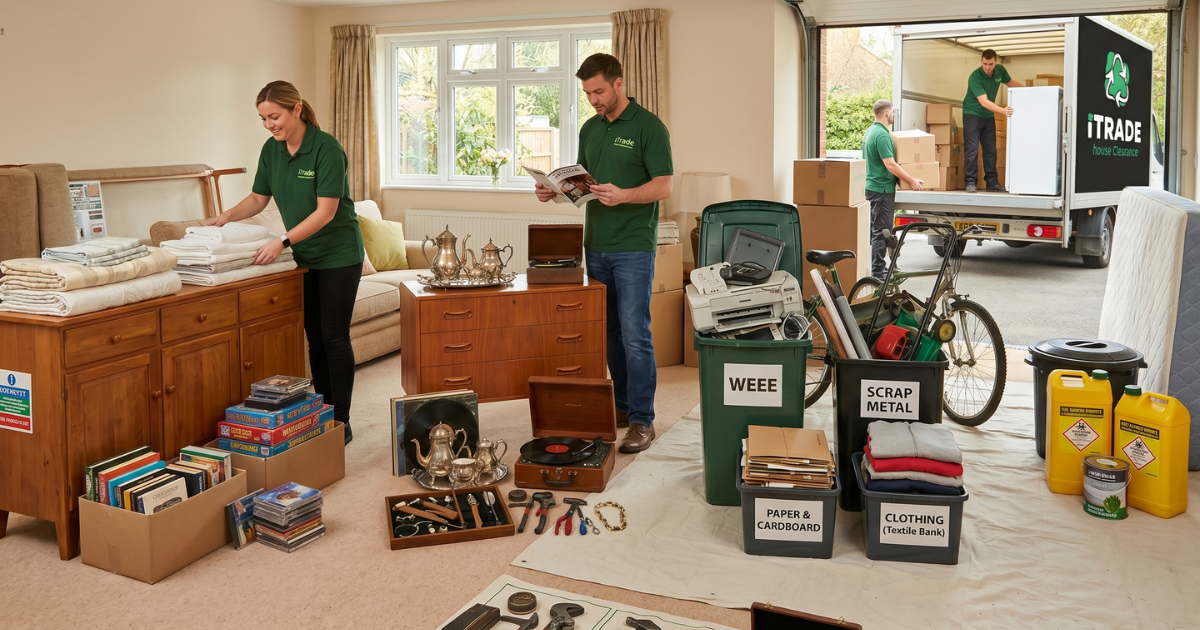
Clearing a house — whether it’s your own, a family member’s, or a property you’ve inherited — is rarely a straightforward task. You’re faced with decades of accumulated belongings, and the pressure to clear everything quickly can make it tempting to skip past the question of what’s actually worth saving, selling, or recycling.
But here’s what most people don’t realise: a significant proportion of items found during a house clearance have genuine resale value, can be donated to support good causes, or can be kept out of landfill through responsible recycling. Getting this right doesn’t just save money — it’s better for the environment, better for the community, and increasingly expected under UK waste legislation.
At iTrade House Clearance, we handle all of this on behalf of our clients every day. In this guide, we’ll walk you through exactly what can be reused, recycled, or sold — and how to make the most of what’s left behind.
What Items Can Be Reused During a House Clearance?
Reuse sits at the top of the waste hierarchy for good reason. If something still works or still looks good, extending its life is far better than breaking it down for recycling or sending it to landfill.
Furniture
Solid wood furniture — sideboards, wardrobes, dining tables, chest of drawers — holds up remarkably well over time. Many pre-1980s pieces were built to a standard that modern flat-pack simply can’t match. Upholstered sofas and armchairs in reasonable condition are also prime candidates for reuse, especially if the frames are still sturdy.
Flat-pack furniture in good condition can also find a second home, though its resale or donation value is generally lower than solid pieces.
Household Textiles and Soft Furnishings
Curtains, cushions, bedding, towels, and rugs that are clean and undamaged can all be passed on. Textile banks and charity shops accept a wide range of fabric items, and some specialist organisations collect curtains specifically for redistribution.
Books, CDs, DVDs and Games
These are easy wins during a clearance. Books in readable condition, DVDs, CDs, and games consoles or boxed games are widely accepted by charity shops and online resale platforms. Children’s books in particular are always in demand.
Garden Equipment and Tools
Manual tools such as spades, forks, rakes, and hand tools are durable and easy to pass on. Larger equipment like lawnmowers and strimmers can also be reused if they’re in working order — and if not, they often still have value as scrap metal or spare parts.
Kitchenware and Small Appliances
Crockery, glassware, pots, pans, and small kitchen appliances such as toasters, kettles, and food processors can all be donated or sold if they’re in good condition. Kitchen equipment is consistently popular in charity shops and at car boot sales.
What Can Be Recycled During a House Clearance?
Where reuse isn’t possible, recycling is the next best option. Getting this right during a clearance can divert a large volume of material from landfill.
Electrical Appliances and WEEE Regulations
Waste electrical and electronic equipment — commonly referred to as WEEE — is subject to specific regulations in the UK. Items like washing machines, fridges, televisions, laptops, printers, and mobile phones cannot be disposed of in general household waste. They must be taken to a WEEE-compliant recycling facility or collected by a registered waste carrier.
This includes both large white goods and smaller electronics. Many local councils offer free collection or designated WEEE recycling points, and retailers are also required by law to accept old electrical items when you purchase a replacement.
At iTrade House Clearance, we handle WEEE disposal in full compliance with these regulations, so you won’t face any liability.
Scrap Metal
Metal is one of the most widely and efficiently recycled materials in the UK. Aluminium, copper, steel and iron — whether found in old tools, appliances, pipes, guttering, or general metalwork — can all be processed through scrap metal recycling. Depending on the type and quantity, scrap metal may also have direct monetary value.
Paper, Card and Packaging
Books too damaged to donate, cardboard boxes, old paperwork, and general paper waste are all recyclable through council collections or household recycling centres.
Glass
Glass bottles, jars, and certain types of decorative glass can be recycled. Note that Pyrex, mirrors, and window glass are typically not accepted in domestic recycling collections and require separate disposal.
Clothing and Textiles
Clothing that’s too worn for donation can still be diverted from landfill through textile recycling banks or specialist clothing collectors. Many councils partner with textile recycling schemes, and charities like Oxfam and the Salvation Army often accept torn or damaged clothing for processing.
What Items Can Be Sold for Value?
A house clearance is also an opportunity for value recovery. You’d be surprised what items command a good price — particularly if the property belonged to someone who accumulated belongings over several decades.
Antiques and Collectibles
Antique furniture, ornaments, silverware, clocks, ceramics, vintage jewellery, and original artwork can be highly valuable. Identifying these pieces requires some knowledge, as genuine antiques are often mixed in with reproduction pieces that look similar but carry no real value. An estate clearance through a company with experience in identifying saleable items is valuable here — rather than discovering too late that a piece was worth selling.
Vintage and Mid-Century Furniture
Mid-century modern furniture — particularly pieces from the 1950s to 1970s — has surged in popularity. G-Plan, Ercol, and Heal’s pieces in original condition regularly achieve strong prices at auction or through specialist dealers.
Vinyl Records and Hi-Fi Equipment
Vinyl records have seen a significant resurgence. Collections found during a house clearance can range from worthless to extremely valuable depending on the artist, pressing, and condition. Original jazz, folk, and progressive rock pressings are particularly sought after. Vintage hi-fi equipment from brands like Leak, Quad, or Wharfedale is similarly collectible.
Tools and Workshop Equipment
Quality hand tools from brands like Stanley, Record, and Marples hold their value well in second-hand markets. Power tools in working condition from brands like DeWalt, Makita, or Bosch can also fetch a reasonable price through resale platforms.
Silver, Gold and Jewellery
Any jewellery, silverware, or items stamped with precious metal hallmarks should be assessed before disposal. Even pieces that appear damaged may contain valuable metals. Hallmarked silver, in particular, is widely bought by dealers and at auction.
Books and First Editions
While most books have little monetary value, first editions, signed copies, or books in specialist subject areas can be worth significant sums. Academic texts, art books, and books with original illustrations also tend to attract collector interest.
Learn More: Environmentally Responsible House Clearance – How It Works
What Should Go to Charity?
Charity donation is one of the most meaningful outcomes of a house clearance. Items that aren’t worth the effort of selling individually but are perfectly usable can go on to support people in real need.
Most charity shops will accept:
- Clean, good-condition clothing and footwear
- Furniture in safe and usable condition (note: upholstered furniture must carry a fire safety label to be accepted)
- Kitchenware, crockery, and glassware
- Books, DVDs, CDs, and games
- Toys and children’s equipment (safety-compliant and complete)
- Small working electrical appliances (though policies vary by charity)
Specialist charities such as the British Heart Foundation, Emmaus, and Shelter often accept larger furniture items and may even offer a collection service. Furniture reuse charities provide affordable household items to people setting up new homes following homelessness or domestic abuse — so the impact of a donated sofa or wardrobe can be genuinely significant.
What Cannot Be Reused or Recycled?
Not everything from a house clearance can be saved. Some materials require careful, regulated disposal and should never be handled carelessly.
Asbestos
Older properties — particularly those built or renovated before the mid-1980s — may contain asbestos in floor tiles, artex ceilings, pipe lagging, or garage roofing panels. Asbestos is a licensed waste requiring specialist removal and disposal. It must never be placed in general skips or taken to household recycling centres.
Hazardous Chemicals and Paints
Old tins of paint (particularly solvent-based), garden chemicals, cleaning products, and oils are classified as hazardous waste. Many local councils run dedicated collection points for household hazardous waste, and some fire stations accept old paint.
Mattresses
Mattresses are not accepted in most recycling facilities due to the complexity of dismantling the materials involved. Some specialist mattress recyclers do operate in the UK, and a small number of councils offer dedicated collection services. A reputable clearance company will have routes for responsible mattress disposal.
Broken Electricals and WEEE Without Recovery Value
While WEEE must be recycled, not all electrical items have component value. Broken items still need to be processed correctly rather than sent to general waste.
The Environmental Benefits of Sorting Correctly During a Clearance
The environmental case for sorting items carefully during a house clearance is compelling. Landfill in the UK is a finite and increasingly expensive resource, and large volumes of perfectly usable material are buried every year simply because people don’t have the time, knowledge, or support to sort it properly.
When approached thoughtfully, a house clearance contributes directly to the circular economy — the economic model in which materials are kept in use for as long as possible, and waste is minimised. Every piece of furniture that finds a new home, every kilogram of metal that’s recycled, and every bag of clothing that reaches a textile processor rather than a landfill site represents a measurable environmental benefit.
Beyond the environmental argument, there are practical implications for homeowners. Fly-tipping and improper waste disposal carry significant fines. Using a licensed and responsible clearance company protects you from any legal exposure and ensures your duty of care under the Environmental Protection Act 1990 is fully met.
Learn More: What Items Are Valuable in a House Clearance?
How iTrade House Clearance Helps With Responsible Disposal
At iTrade House Clearance, responsible disposal isn’t a feature we’ve added on — it’s central to how we work. We understand that the contents of a home represent years of someone’s life, and we treat every clearance accordingly.
Here’s what that means in practice:
Value recovery first. Before anything is disposed of, we assess items for resale value, donation potential, and reuse. Items with genuine value are not discarded.
Charity partnerships. We work with local charities and furniture reuse organisations to ensure that usable items reach people who need them.
WEEE-compliant disposal. All electrical items are handled in line with UK WEEE regulations. We are a registered waste carrier, and every load is documented.
Scrap metal processing. Metal removed during a clearance is directed to scrap metal recyclers rather than general waste.
No unnecessary landfill. We aim to divert as much material as possible from landfill through sorting, recycling, and donation before disposal is considered.
Full documentation. We provide a waste transfer note for every clearance, giving you the documentation you need to demonstrate your legal duty of care has been met.
Whether you’re dealing with an estate clearance, downsizing, or a full property clear-out, iTrade House Clearance manages the entire process — from sorting and loading to responsible disposal — with care, efficiency, and full regulatory compliance.
