

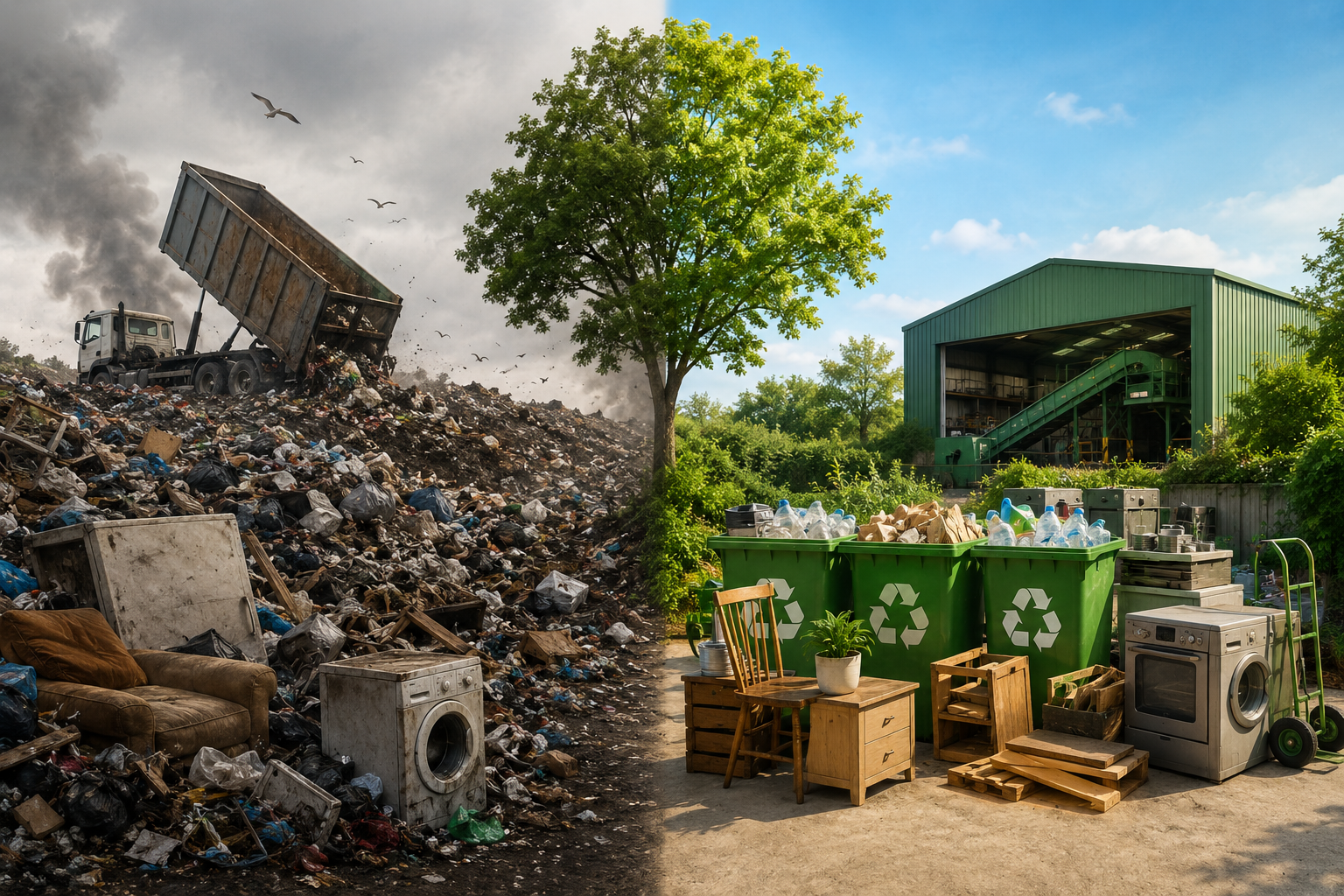
If you’ve ever stood next to a skip full of old furniture, broken appliances, and bin bags wondering “does any of this actually get sorted, or does it all just end up in the same hole in the ground?” — you’re not alone. It’s one of the most common questions our team at iTrade House Clearance Norfolk gets asked on every single job.
The honest answer is: it depends entirely on who is clearing your property and how they handle what comes out of it. Landfill and recycling are not two equal options sitting side by side. They’re two completely different journeys for your waste, with very different environmental costs — and knowing the difference helps you understand why responsible house clearance matters so much more than people think.
Let’s break it down properly.
What Is Landfill, Really?
Landfill is the oldest and simplest method of waste disposal: rubbish is collected, compacted, and buried in engineered cells lined with clay or synthetic membranes designed to contain it. Once a cell is full, it’s capped and left — sometimes for decades — while the waste inside slowly breaks down.
That breakdown process is the real problem. Organic material decomposing without oxygen (a process called anaerobic decomposition) produces methane, a greenhouse gas more than 25 times more potent than carbon dioxide over a 100-year period. Landfill sites also generate leachate — a toxic liquid created as rainwater filters through buried waste, picking up chemicals, heavy metals, and contaminants along the way. Without proper lining and drainage systems, leachate can migrate into surrounding soil and groundwater.
In the UK, landfill is now the bottom rung of the waste hierarchy — the government framework (enforced by the Environment Agency) that ranks disposal methods from most to least preferable: prevention, reuse, recycling, recovery, and finally, disposal. Landfill Tax, introduced specifically to discourage burial of waste, currently sits at a rate high enough that it directly increases the cost of any clearance company that isn’t sorting material properly.
It’s worth understanding why the system was built this way. Before Landfill Tax existed, burying waste was simply the cheapest option available, so almost everything ended up underground regardless of whether it could have been reused or recycled. The tax — which has risen steadily year on year — was designed to make landfill the financially unattractive choice, pushing waste producers and clearance companies toward sorting and diversion instead. The knock-on effect is that landfill sites themselves are becoming a shrinking, tightly regulated piece of infrastructure rather than the default endpoint for household waste. Modern sites require engineered liners, gas capture systems to manage methane, and ongoing environmental monitoring that can continue for years after a site closes. None of that comes cheap, which is reflected in the rising cost of landfill disposal across the board.
What Is Recycling, and How Does It Actually Work?
Recycling takes a completely different path. Rather than burying material, recyclable waste is sorted, processed, and converted back into raw material that re-enters the manufacturing supply chain.
When mixed waste from a house clearance arrives at a Material Recovery Facility (MRF), it’s separated by category — metals, wood, cardboard, textiles, electricals, plastics, and general residual waste. Each stream then follows its own route:
- Metals are melted down and reformed — aluminium and steel can be recycled almost infinitely without losing quality.
- WEEE (Waste Electrical and Electronic Equipment) — old TVs, microwaves, kettles — is processed under strict WEEE Regulations to recover valuable components and safely handle hazardous parts like batteries and circuit boards.
- Wood and furniture is either reused, donated, or chipped down for biomass and particleboard manufacturing.
- Textiles are graded for reuse, resale, or fibre reclamation.
This is the part most people don’t realise: a genuinely good house clearance company isn’t just “taking stuff to the tip.” They’re operating closer to a logistics and sorting operation, diverting as much as possible away from landfill before residual waste — the small fraction that truly can’t be reused or recycled — is sent for disposal as a last resort.
The bigger idea underpinning all of this is the circular economy — a model where materials are kept in use for as long as possible rather than extracted, used once, and discarded. Every tonne of steel recovered from an old washing machine is a tonne that doesn’t need to be mined and smelted from raw ore. Every piece of furniture rehomed through a reuse scheme is one less item that needs manufacturing from scratch. Recycling isn’t just about keeping things out of the ground — it’s about reducing the demand for new raw materials in the first place, which carries its own significant environmental footprint in mining, logging, and energy use.
There’s also a quality dimension worth mentioning. Not all recycling is equal. Some materials, like glass and most metals, can be recycled almost indefinitely without any loss of quality — this is sometimes called closed-loop recycling. Others, like many plastics, degrade slightly with each reprocessing cycle, eventually becoming unsuitable for further recycling — known as downcycling. This is one reason why correctly sorting waste at the point of collection matters so much: contamination between streams (food residue in cardboard recycling, for example) can downgrade or even disqualify an entire batch from being processed properly.
Learn More: Can House Clearance Companies Remove Hazardous Waste?
Landfill vs Recycling: The Key Differences
| Landfill | Recycling | |
| Process | Waste is buried in engineered ground cells | Waste is sorted, processed, and remanufactured |
| Environmental impact | Methane emissions, leachate contamination risk | Reduced raw material extraction, lower emissions |
| Material outcome | Permanently lost from the supply chain | Re-enters manufacturing as new products |
| Cost trend | Rising due to Landfill Tax | Often lower per tonne, especially for sorted loads |
| Position in waste hierarchy | Last resort | Strongly preferred |
| Timeframe to break down | Some materials take centuries | Materials can be reprocessed in weeks |
Why This Matters During a House Clearance
A typical house clearance — particularly probate clearances, downsizing moves, or property handovers — generates a huge volume of mixed waste in a very short space of time. That volume is exactly why the disposal method matters so much. Send everything to landfill in one go, and you’re contributing a significant, avoidable spike of methane-producing and potentially contaminating material in a single trip.
This is also where licensed waste carrier status becomes important. Under UK law, anyone removing waste from a property on a commercial basis must be registered with the Environment Agency and must provide a waste transfer note documenting where the waste went. This isn’t paperwork for its own sake — it’s the legal trail that proves your waste wasn’t fly-tipped or dumped illegally, which property owners can be held liable for even when they hired someone else to do the clearance.
How iTrade House Clearance Norfolk Handles It Differently
At iTrade House Clearance Norfolk, sorting happens before disposal, not after. Every clearance is approached with the waste hierarchy in mind: items in good condition are set aside for reuse or donation, metals and electricals are separated for specialist recycling, and only genuine residual waste — the fraction with no viable recovery route — goes to landfill.
We’re a fully licensed waste carrier, which means every clearance comes with proper documentation and a transparent record of where your waste actually ends up. For households across Norfolk, that means a clearance that’s not just fast and stress-free, but genuinely accountable.
Learn More: How to Dispose of Old Appliances Legally and Responsibly
The Bottom Line
Landfill and recycling aren’t interchangeable disposal methods — they’re opposite ends of the waste hierarchy, with very different environmental footprints and very different long-term costs. The difference comes down almost entirely to whether the company clearing your property bothers to sort material before it’s gone for good.
If you’re planning a house clearance in Norfolk and want it handled properly — sorted, documented, and disposed of responsibly — iTrade House Clearance Norfolk is built around exactly that standard.
