

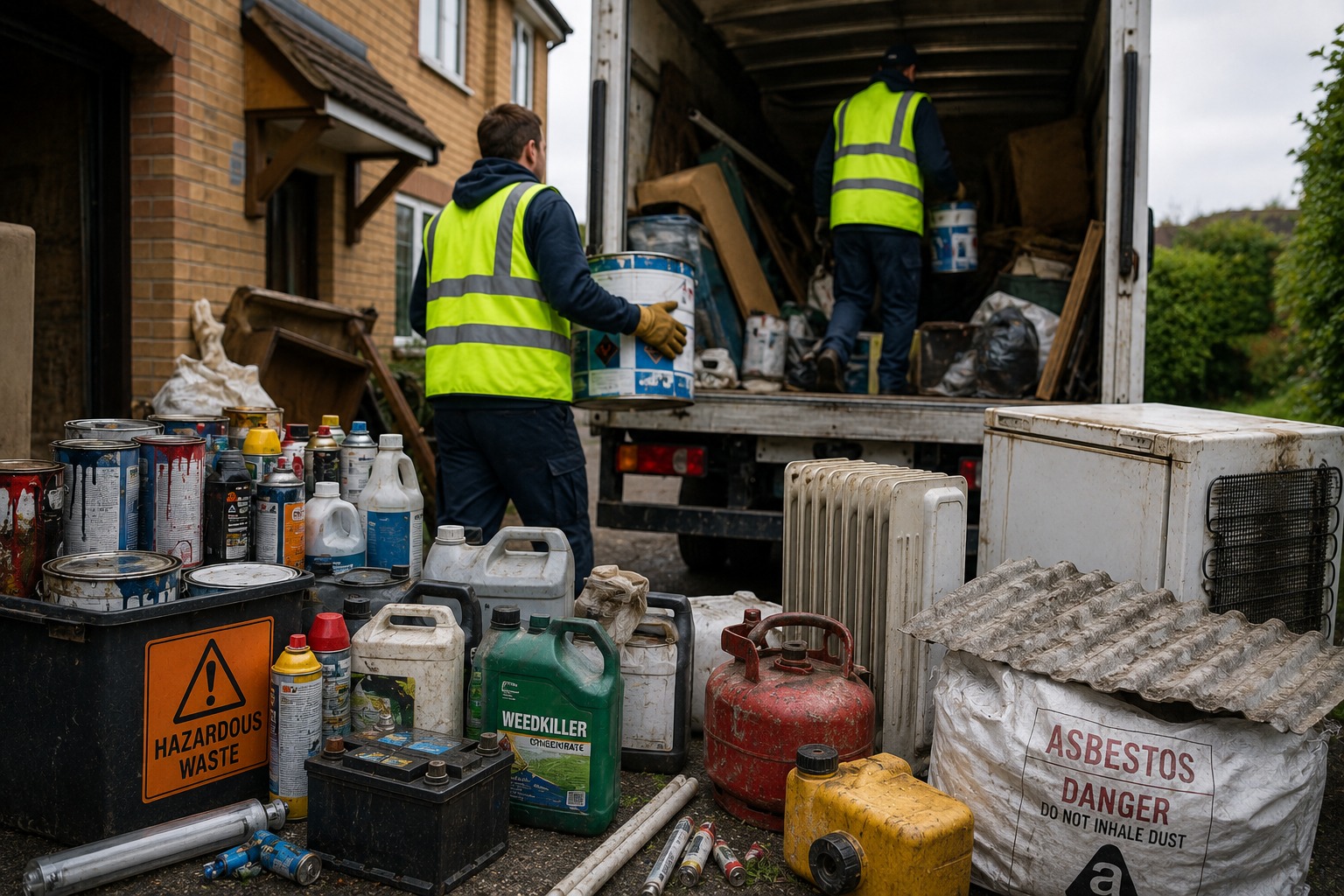
Yes — some house clearance companies can remove certain hazardous waste, but there is an important catch: not every hazardous item can be thrown into a clearance van, mixed with general rubbish, or taken to a standard disposal site.
A responsible house clearance company must know the difference between ordinary household waste and materials that need specialist handling. Hazardous waste is generally waste that can harm people or the environment, and common examples include asbestos, chemicals, batteries, solvents, pesticides, oils, fridges, and hazardous containers.
For customers in Norfolk, this matters because many house clearances involve sheds, garages, lofts, outbuildings, workshops, probate properties, and long-neglected cupboards where the “awkward stuff” tends to live. At iTrade House Clearance Norfolk, the priority is simple: clear the property efficiently, but never cut corners with safety, legal disposal, or environmental responsibility.
The Short Answer: Sometimes, But Not Always
A house clearance company may be able to deal with certain hazardous household items if they are authorised, properly equipped, and using the correct disposal route. However, some materials require a specialist contractor, particularly asbestos, clinical waste, sharps, fuels, certain chemicals, and other high-risk substances.
In England, businesses that collect and transport hazardous waste must follow specific steps, including registering as a waste carrier, checking waste classification, separating waste correctly, completing the relevant paperwork where required, and taking waste to an authorised site.
That means the real question is not simply, “Can a house clearance company remove hazardous waste?” The better question is:
Can this company remove this specific hazardous item legally, safely, and with the right disposal route?
That is where experience matters.
What Counts as Hazardous Waste in a House Clearance?
Hazardous waste is not always dramatic-looking. It is rarely sitting there with a skull-and-crossbones label waving politely for attention. Often, it looks like ordinary household clutter.
During a house clearance, hazardous or potentially hazardous waste may include:
- Old paint tins, especially liquid paint
- Paint thinners, white spirit, solvents, and brush cleaners
- Pesticides, weed killer, fertilisers, and garden chemicals
- Car batteries, lithium batteries, and power tool batteries
- Fluorescent tubes and certain light bulbs
- Fridges, freezers, and appliances containing gases
- Gas bottles and cylinders
- Waste oil, fuel, petrol, diesel, and heating oil
- Fire extinguishers
- Medicines, sharps, syringes, and clinical waste
- Asbestos-containing materials, such as old garage roofing, certain floor tiles, pipe lagging, storage heaters, and some older building materials
Norfolk County Council defines hazardous waste as waste that can cause harm to humans or the environment and includes waste needing specialist disposal. The council also states that hazardous items are not normally accepted at recycling centres, although annual household hazardous waste days are held for certain accepted items.
Why Hazardous Waste Cannot Be Treated Like Normal Rubbish
A standard house clearance is usually straightforward: furniture, bric-a-brac, carpets, general household contents, white goods, garden items, and mixed waste are sorted, loaded, reused, recycled, or disposed of correctly.
Hazardous waste is different.
It may leak, burn, react with other materials, release fumes, contaminate other waste, injure clearance staff, or create problems at the disposal site. A half-full tin of old paint is not the same as a broken chair. A suspected asbestos panel is not the same as a sheet of plywood. A box of sharps in a bathroom cabinet is not “just another box.”
There is also a duty-of-care issue. Householders using a private business for waste collection, including house clearance, should check that the business is an authorised waste carrier with valid upper-tier registration. GOV.UK says this can be checked using the Environment Agency’s public register.
A cheap “we’ll take anything, no questions asked” clearance may sound convenient, but that is often where trouble starts. Proper clearance is not just about removing items from a property. It is about making sure they end up in the right place.
Can iTrade House Clearance Norfolk Remove Hazardous Waste?
iTrade House Clearance Norfolk can help identify, separate, and advise on hazardous or suspected hazardous waste during a house clearance. Where an item requires specialist disposal, the correct approach is to arrange or recommend the appropriate specialist route rather than mixing it into a general clearance load.
That is the professional answer. No drama, no guesswork, no “it’ll probably be fine.”
For ordinary clearance items, the team can remove and process them through suitable reuse, recycling, and disposal routes. For hazardous items, the process depends on the item itself, its condition, whether it is domestic or commercial waste, and whether specialist handling is legally required.
Learn More: Urgent House Clearance Norfolk – What To Do When You Need It Done Fast
Hazardous Items That Often Need Specialist Disposal
Asbestos
Asbestos is the big one. If there is suspected asbestos in a property, it should not be disturbed, broken up, swept, bagged casually, or loaded with general waste.
Norfolk County Council states that asbestos is hazardous waste and is not accepted at any of its recycling centres, even during hazardous waste events. The council advises using a specialist licensed contractor for asbestos removal and disposal.
The Health and Safety Executive also provides asbestos safety guidance covering dangers, locations, risk assessment, licensed contractors, and the law.
Liquid Paint
Old paint is one of the most common finds in sheds, garages, and under-stairs cupboards. Norfolk County Council says liquid paint should never be put in your bin and is not accepted at recycling centres except on annual household hazardous waste days. The council also advises using up, donating, or drying out unused paint where appropriate.
A house clearance company may be able to remove empty tins or dried paint waste depending on the circumstances, but liquid paint needs a more careful route.
Chemicals, Pesticides, and Solvents
Garden chemicals, cleaning chemicals, brake fluid, drain cleaners, thinners, preservatives, and similar products are not general rubbish. Norfolk lists several chemical items as accepted only during household hazardous waste days, while some other hazardous items are never accepted and require specialist options.
This is exactly why a good pre-clearance survey matters. The dangerous items are not always in the house. They are often in the garage, shed, greenhouse, or outbuilding.
Medicines, Sharps, and Clinical Waste
Sharps, syringes, needles, medicines, and clinical waste should not be mixed into a normal house clearance. Norfolk’s hazardous waste guidance lists medicines, medical equipment, sharps, syringes, needles, and clinical waste among items not accepted at any time through its household hazardous waste arrangements, with specialist disposal routes needed.
Fuels, Oil Tanks, and Gas Bottles
Petrol, diesel, heating oil, part-full oil tanks, and full or partially full gas bottles are another category where caution is essential. Norfolk’s guidance says full or partially full gas bottles and fuels are not accepted through its hazardous waste arrangements and require other specialist or supplier routes.
What Should Happen During a Safe House Clearance?
A safe hazardous-waste-aware house clearance should follow a sensible process.
1. Identify the Risk Early
Before the clearance begins, tell the company about anything unusual: old chemicals, asbestos-looking boards, medical waste, fuel, paint, gas bottles, or unknown containers.
A few photos can save time, money, and risk. Better to flag it early than discover it when the van is already half-loaded.
2. Separate Hazardous Items
Hazardous waste should not be mixed with furniture, general rubbish, textiles, or recyclable materials. GOV.UK guidance for hazardous waste carriers includes separating waste correctly when loading it for transport.
3. Check Authorisation
For householder peace of mind, always use a legitimate clearance company. GOV.UK advises householders to check whether a private business taking their waste is an authorised carrier with valid upper-tier registration.
4. Use the Correct Disposal Route
Some hazardous household waste may go through council hazardous waste days. Some may require a hazardous waste contractor. Some, such as asbestos, may need a specialist licensed contractor. Some items may need to be returned to the supplier or handled through a specialist collection.
5. Keep Evidence
Receipts, waste transfer details, photographs, or contractor information can help show that waste was handled responsibly. GOV.UK notes that householders can record checks or keep receipts to demonstrate that they used a registered operator if waste is later investigated.
Can Hazardous Waste Be Removed From Probate Properties?
Yes, but probate clearances often need extra care.
A property that has been lived in for decades may contain old medicine, garage chemicals, asbestos-containing materials, oil, gas bottles, outdated appliances, and forgotten DIY products. Nobody wants surprises during a probate clearance, especially when family members are already dealing with paperwork, deadlines, and emotion.
The best approach is to arrange a proper survey first. iTrade House Clearance Norfolk can assess the property contents, separate standard clearance items from potential hazards, and advise on the safest next step for anything that cannot be handled through normal clearance routes.
Can Hazardous Waste Go in a Skip?
Usually, no. Hazardous waste should not be hidden in a skip or mixed with ordinary household clearance waste. Skips and general clearance loads have rules about what they can accept, and hazardous items may cause the entire load to be rejected or create extra disposal costs.
If an item is hazardous, treat it as hazardous from the start. That is cheaper and safer than trying to fix the problem after it has been mixed into a load.
Learn More: How to Clear a Hoarder House Safely and Efficiently
Why Choosing the Right House Clearance Company Matters
The right company will not simply empty a property as fast as possible. It will look at the job properly, ask the right questions, identify risk areas, and explain what can and cannot be removed.
For Norfolk homeowners, landlords, estate agents, solicitors, and families handling probate, that matters. A responsible clearance protects the property owner, the clearance team, the environment, and the wider community.
iTrade House Clearance Norfolk offers a practical, straight-talking approach to clearances. The aim is to remove what can be removed safely, flag what needs special treatment, and make the process as smooth as possible without pretending hazardous waste is ordinary rubbish.
Final Verdict: Can House Clearance Companies Remove Hazardous Waste?
Yes, house clearance companies can remove some hazardous waste, but only when the waste type, authorisation, handling, paperwork, and disposal route are correct.
Some items may be suitable for removal by an authorised waste carrier. Others must be handled by specialist hazardous waste or asbestos contractors. The safest approach is to identify suspicious materials early, avoid disturbing them, and ask a professional before anything is moved.For a house clearance in Norfolk, iTrade House Clearance Norfolk can help you understand what is straightforward, what needs separating, and what requires specialist disposal. That is how a proper clearance should be done: safely, legally, and with no cowboy shortcuts.
