

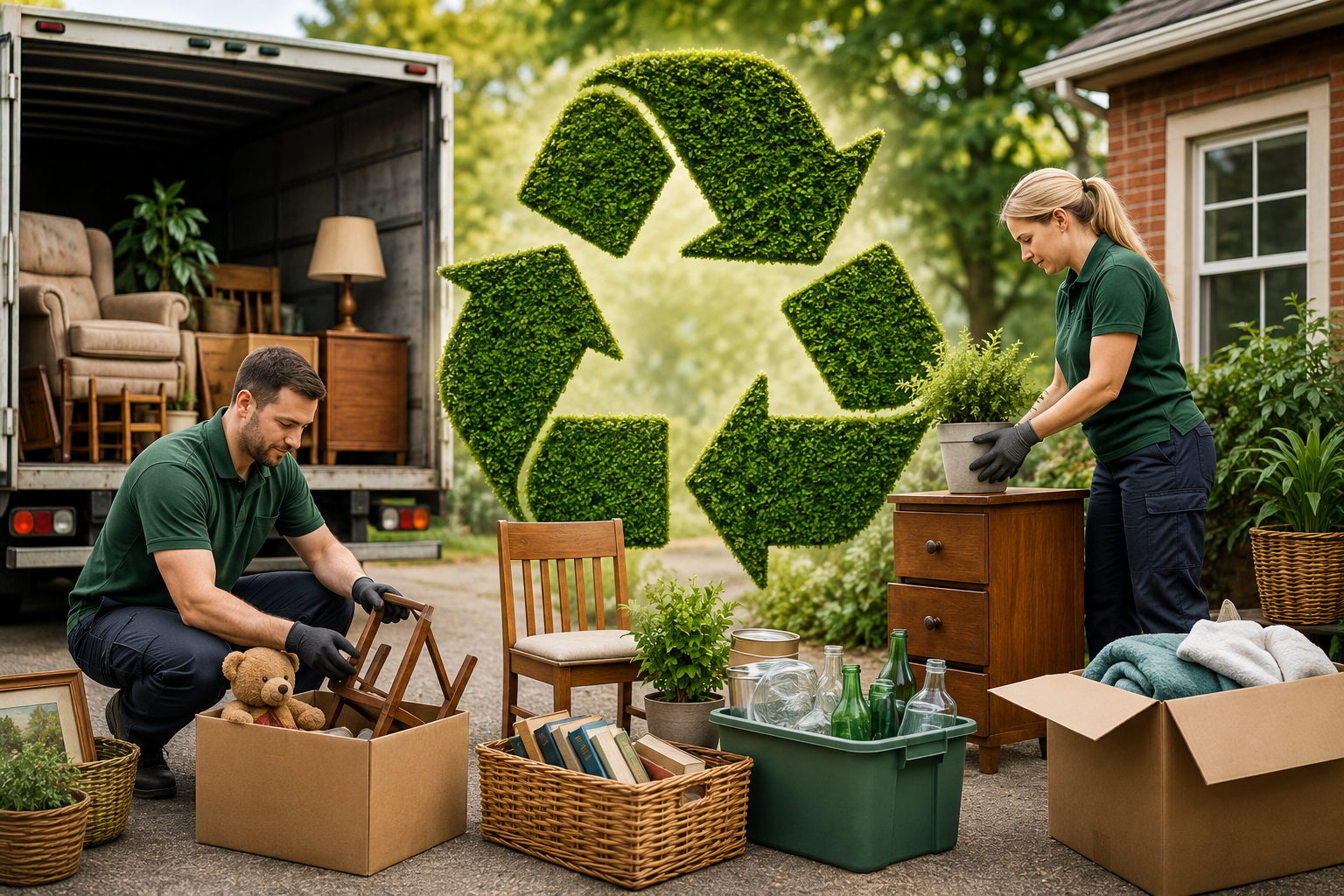
When most people picture a house clearance, they picture a skip. Furniture, boxes, old appliances, and the contents of a loft that hasn’t been touched in a decade, all heading in one direction: away. At iTrade House Clearance Norfolk, we see it differently. Every clearance we carry out, whether it’s a single garage in Cromer or a full bereavement clearance in North Walsham, starts with the same question: what can be saved before anything is thrown away?
After 25+ years working in Norfolk homes, we’ve built a process that treats landfill as the last option, not the default one. This guide explains exactly how that works, item by item, so you know where your unwanted belongings actually end up.
Why Waste Reduction Matters in a House Clearance
Most of what comes out of a typical Norfolk property during a clearance isn’t rubbish in the true sense, it’s simply unwanted. A working washing machine, a solid wardrobe, a box of tools, a bag of clothes: none of that needs to go to landfill just because someone no longer has room for it.
There’s also a compliance side that’s easy to overlook. Under the Environmental Protection Act, anyone who arranges for waste to be removed from their property has a duty of care to make sure it’s handled by a properly authorised carrier. Waste that’s passed to an unlicensed “man with a van” too often ends up fly-tipped in a layby or field somewhere in Norfolk, and that liability can trace back to the person who paid for the job. Working with a registered waste carrier isn’t just better for the environment, it protects you too.
Our Waste Hierarchy: How We Decide What Happens to Each Item
We follow the same principle that underpins UK waste policy: reduce, reuse, recycle, recover, and only then, dispose. In practice, that means every single item is assessed against this order before it’s classed as waste at all.
| Step | What It Means | How We Apply It |
| Reduce | Preventing unnecessary waste | Sorting on-site so nothing usable is cleared needlessly |
| Reuse | Keeping items in circulation | Reselling or redistributing furniture, appliances, and goods in good condition |
| Recycle | Turning materials into new products | Separating wood, metal, glass, paper, and plastics for licensed recycling |
| Recover | Extracting value from what’s left | Sending non-recyclable residual waste for energy recovery where possible |
| Dispose | Landfill | Used only when every other option has been ruled out |
Step 1: Sorting on Site, Before Anything Leaves the Property
Sorting doesn’t happen back at a depot, it happens in the room you’re standing in. Our team works through a property methodically, separating keepsakes and items of sentimental value, anything with resale worth, donation-quality goods, recyclable materials, and genuine rubbish, before a single item is loaded into the van. This is what allows us to divert far more from landfill than a straight “clear everything into a skip” approach ever could.
Step 2: Reuse and Resale First
Furniture, electricals, and household goods in reasonable condition are assessed for resale rather than automatically written off. Where items have value, this can also help offset the cost of the clearance itself, something we factor into quotes for probate clearance in Norfolk and downsizing clearance in Norfolk in particular, where families are often clearing a lifetime of belongings at once.
Step 3: Donating to Local Charities and Community Groups
Anything that’s usable but not resold is offered to local Norfolk charities, community groups, and reuse projects wherever practical, furniture, clothing, books, toys, and kitchenware included. This keeps good-quality items out of the waste stream entirely and puts them back into use for someone who needs them, rather than sending them straight to be broken down or burned.
Step 4: Recycling Materials Correctly
Everything that can’t be reused is separated by material rather than dumped together. Wood, metal, glass, cardboard, and plastics are sorted and sent to the appropriate licensed recycling facilities. Mixing these streams is one of the most common ways clearance waste ends up in landfill unnecessarily, so this separation happens as standard on every job, not as an optional extra.
Step 5: Landfill as an Absolute Last Resort
Only what genuinely cannot be reused, recycled, or recovered is sent to landfill. It’s the final stage of the process, not the starting point, and on most clearances it’s a small fraction of what’s removed from the property.
What Happens to Different Types of Items
Furniture and Household Goods
Sofas, wardrobes, tables, and beds in good condition are prioritised for resale or donation. Damaged pieces are broken down where possible so that individual materials, wood, fabric, metal fixings, can still be recycled separately rather than the whole item being written off as one.
Electrical Items and White Goods (WEEE)
Fridges, freezers, washing machines, TVs, and other electricals fall under the WEEE (Waste Electrical and Electronic Equipment) Regulations and can’t simply go in with general waste. Items containing refrigerants need specialist degassing before they’re processed. We handle electrical items in line with these requirements and send them to an authorised treatment facility rather than a standard waste stream.
Textiles, Clothing and Linens
Clothing, curtains, and bedding are sorted for charity donation or textile recycling wherever condition allows. Textiles are one of the easiest categories to divert from landfill, yet one of the most commonly binned by mistake during a rushed clearance.
Metal, Wood and Garden Waste
Scrap metal, timber, fencing, and garden waste from sheds and outdoor spaces are collected and recycled separately. This is especially relevant for garage clearances, which tend to produce a disproportionate amount of metal and timber compared to indoor rooms.
Hazardous, Restricted and Confidential Items
Paint, chemicals, and unused medicines are categories many clearance services won’t touch, but we accept and dispose of them correctly rather than leaving them behind as your problem. Confidential paperwork, bank statements, medical records, personal documents, is destroyed securely, which matters when you’re clearing a family member’s home or acting as an executor.
Licensed and Responsible Waste Disposal You Can Rely On
As a registered waste carrier, we operate under the same duty of care obligations that apply to any business handling household and commercial waste in England. That means your waste is tracked, transported, and disposed of through licensed channels, not passed informally to an unauthorised third party. On request, we can provide a waste transfer note as evidence of correct disposal, useful documentation if you’re a landlord, letting agent, or solicitor who needs to show compliance.
Learn more: Bulky Waste Removal vs Council Collection in Norfolk
How Waste Reduction Fits Probate, Downsizing and Landlord Clearances
Waste reduction looks slightly different depending on the type of clearance:
- Probate clearances often involve sorting through decades of belongings with care and sensitivity, identifying items of value early on genuinely helps offset costs for the family, alongside handling everything else responsibly.
- Downsizing clearances tend to involve a mix of items someone wants to keep, sell, donate, and dispose of, so on-site sorting matters more here than almost anywhere else.
- Landlord clearances are often time-pressured between tenancies, but speed doesn’t come at the expense of responsible disposal. Furniture left behind by outgoing tenants is still assessed for reuse before it’s classed as waste.
Learn more: Rubbish Removal in Norfolk: What Can and Cannot Be Taken?
The Difference This Makes Across Norfolk
We carry out clearances across North Walsham, Norwich, Cromer, Sheringham, Great Yarmouth, King’s Lynn, Dereham, Wroxham, Aylsham, and the surrounding villages, and the same sorting process applies wherever the job is. Every item reused is one less item manufactured from scratch, every item recycled is one less item mined or processed as raw material, and every donation keeps goods circulating locally rather than being replaced new. Multiplied across the number of clearances a team like ours completes in a year, that adds up to a meaningful reduction in what actually reaches Norfolk’s landfill sites.
